 English
 العربية
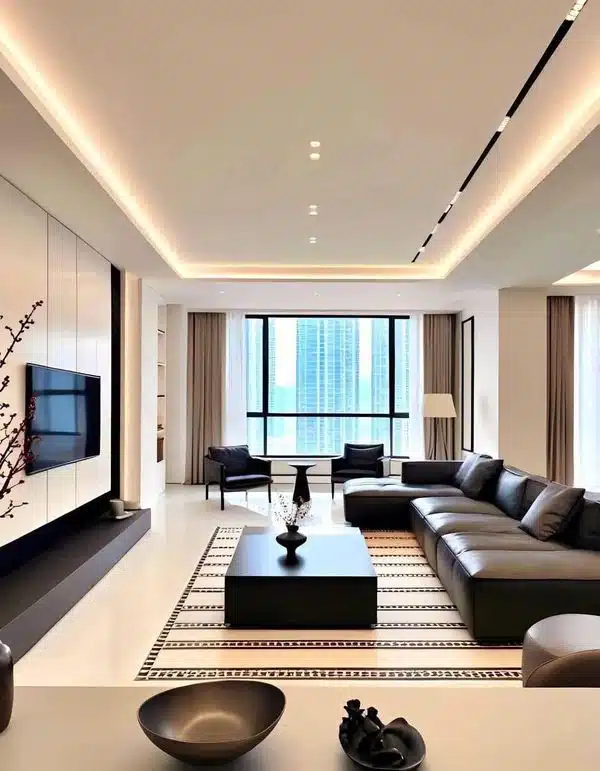
Master the art of track lighting with our comprehensive 2025 guide. Discover how to use this flexible system to create professional lighting layers and highlight the beauty of your home or store.
In the world of interior design, we often seek solutions that combine practical function, artistic beauty, and the flexibility to adapt to our changing lives. Few lighting systems can achieve this difficult equation with the same efficiency and elegance as track lighting. For a long time, this system suffered from a bad reputation, associated in many minds with a purely industrial look, art galleries and museums, or the ceilings of old houses from the 1980s. But this stereotype has been completely shattered.
Track lighting has undergone a tremendous design and technological revolution. It is no longer just bulky metal bars, but has become sleek, simple, and sophisticated systems capable of being the hidden hero in any modern interior design. It is no longer just a problem-solver, but a powerful creative tool in the hands of designers and homeowners alike. The “art of track lighting” is the art of understanding its limitless potential and using it not just to light a room, but to sculpt it with light, direct attention, and create dynamic visual scenes that change with the touch of a hand.
In this comprehensive and detailed guide, spanning over 3500 words, we will deconstruct the track lighting system into its basic components, explore the arts of its various applications, and present a treasure trove of practical ideas for every room in the house and commercial spaces. We will learn how to transform this system from a merely functional solution into a bold design statement, and we will discover how choosing high-quality components from trusted brands like Nawartt is the key to achieving a lighting system that is not only distinguished by its flexibility, but also by its beauty, performance, and durability for years to come.

Part One: Deconstructing Track Lighting – The Anatomy of a System
To understand the power of this system, we must first break it down into its basic parts. Knowing these components is the first step toward designing a successful system.
Chapter 1.1: The Track (The Backbone of the System) The track is the main part, a channel or rail that contains copper electrical conductors along its length, allowing fixture heads to be connected at any point on it.
- Types of Tracks:
- Standard Linear Tracks: The most common type, available in various lengths (e.g., 1, 2, 3 meters) that can be cut or connected.
- Monorail Systems: Consist of a single rail that can often be bent and shaped into curves, giving it a more artistic and sculptural appearance. Ideal for decorative applications.
- Cable/Suspended Systems: Use two parallel metal cables stretched across the room, on which the light heads are hung. This solution is ideal for very high or sloped ceilings, or in places where direct ceiling mounting is difficult.
- Power Systems:
- Line Voltage (220V): The most common and easiest system. The track is connected directly to the main electrical current.
- Low Voltage (12V/24V): This system requires a transformer to reduce the voltage. Its advantage is that it allows for the use of smaller, more precise fixture heads, and is common in monorail and cable systems.
- Mounting Options: Tracks can be surface-mounted directly to the ceiling, suspended by wires, or recessed into a gypsum ceiling for a more integrated and clean look.
Chapter 1.2: Connectors and Power Feeds (The Joints) These are the small pieces that allow you to build complex shapes and supply power to the system.
- Connectors: Come in various shapes like an “I” connector (to connect two tracks in a straight line), an “L” connector (for right angles), “T” and “X” connectors to create intersecting grids, as well as flexible connectors.
- Power Feeds: The point where electricity is connected to the track. It can be at the end of the track (End Feed), at any point along it via a special connector (I-Connector Feed), or through a floating power canopy.
Chapter 1.3: The Fixture Heads (The Stars of the Show) These are the parts that produce light, and they determine the entire system’s look and performance. The variety here is immense.
- Types of Heads:
- Spotlight Heads: The most common, designed to produce a focused, directional beam of light. Ideal for accent lighting.
- Floodlight Heads: Produce a wide beam for washing walls with light or providing general illumination.
- Pendant Heads: Allow a small pendant to be hung from the track, ideal over tables or kitchen islands.
- Linear Heads: Small light bars that can be mounted on the track to provide linear lighting. The quality of these heads is the decisive factor. High-quality heads from brands like Nawartt feature precise optics (lenses and reflectors) that control the beam shape, a high Color Rendering Index (CRI), and excellent thermal management that ensures a long life for the LED source.
Chapter 1.4: Track System Standards (The Compatibility Puzzle) This is a crucial technical point to understand before buying. There are three main standards that are not compatible with each other:
- H-Type (Halo): A three-conductor system.
- J-Type (Juno): A two-conductor system with a specific spacing between the conductors.
- L-Type (Lightolier): A two-conductor system with a different spacing from J-Type. This means an “H” type fixture head will not work on a “J” type track. It is essential to ensure the track type matches the fixture head type. Reliable companies like Nawartt provide clear information about the system standard their products adhere to, protecting customers from costly mistakes.
Part Two: The Art of Application – Track Lighting as a Design Tool
Now that we understand the components, let’s see how they can be used as a powerful design tool.
Chapter 2.1: The Ultimate Problem Solver The greatest advantage of track lighting is flexibility. This flexibility makes it the ideal solution in many difficult situations:
- For Rental Apartments: Where you can’t drill the ceiling for multiple recessed lights.
- For Art Collectors: Who constantly change the placement of their paintings.
- For Concrete Ceilings: Where it is difficult to establish new electrical points.
- For Multi-use Rooms: Where you need to change the light distribution easily.
Chapter 2.2: Achieving the Three Layers with a Single System This is the true power of track lighting. A single system can provide all three layers of light:
- Ambient Lighting: Using wide-beam flood heads aimed at walls (wall washing) or ceilings (indirect lighting) to create a general, comfortable glow.
- Task Lighting: Using a pendant head over a side table, or a spotlight aimed precisely at a reading chair.
- Accent Lighting: This is where track lighting truly shines. Using narrow-beam spotlight heads, you can highlight any element you want to emphasize with extreme precision.
Chapter 2.3: Design Techniques with Track Lighting
- Wall Washing: Install the track about 60-90 cm from the wall. Use flood heads and aim them towards the wall at an angle. This makes the room feel larger and brighter.
- Lighting Artwork: Install the track at a distance that allows you to aim the light at the painting at an approximately 30-degree angle. This is the ideal angle to minimize glare and reflections. The precision optics in track heads from Nawartt are essential here to achieve a clean, defined light without stray light spill that can distract the viewer.
- Cross-Lighting: To light a sculpture or a three-dimensional object, use two heads from different directions aimed at the object. This highlights its form and reduces harsh shadows.
- Creating Visual Rhythm: Evenly spaced fixture heads along a wall can be used to create a repeating pattern of light and shadow, adding rhythm and movement to the design.

Part Three: A Gallery of Ideas – Track Lighting Applications in Every Room
- Living Room: The most common application. Ideal for creating a changing “gallery wall,” highlighting a fireplace and library, or providing flexible general illumination. A stylishly designed track can be a decor piece in itself.
- Kitchen: A track system can be used over a kitchen island as a modern and flexible alternative to traditional pendants. The lights can be aimed as needed, whether for prep or dining. Using high-CRI heads (above 90), like those provided by Nawartt, is crucial here for seeing the true colors of food.
- Bedroom: It may not be the first choice, but it is a clever solution for illuminating a large wardrobe facade from ceiling to floor. A single track can cover the entire facade with even light. Dimmable heads with a warm color temperature (2700K) must be used.
- Home Office or Studio: Here, the genius of track lighting is revealed. It provides the absolute flexibility to direct light onto the desk, the drawing board, or bookshelves, and to change the distribution according to the current project.
- Hallways and Entryways: Instead of a series of boring ceiling lights, a single track can wash an entire wall with light, making the hallway feel wider and more inviting, and turning it into a space to display family photos.
- Rooms with High or Sloped Ceilings: Suspended cable or monorail track systems are the perfect solution to bring the light source down to a human level and make the space feel more intimate.
Part Four: The Practical Guide – Choosing and Installing Your Track Lighting System
Chapter 4.1: The Checklist for the Right Choice
- Define the Function First: Do you need ambient, task, or accent lighting? This determines the head type and beam angle.
- Choose the Track Type: Do you need the flexibility of a monorail or the simplicity of a linear track?
- Verify the Compatibility Standard: Choose the track and heads of the same standard (H, J, L).
- Scrutinize the Technical Specs of the Heads:
- CRI: No less than 90 for residential spaces.
- CCT: Choose 2700K-3000K for warm atmospheres.
- Lumen: Choose the appropriate brightness for the task.
- Beam Angle: Narrow for accent, wide for washing. You can rely on trusted sources like Nawartt to provide a wide range of options that meet these specifications accurately.


Chapter 4.2: Common Mistakes to Avoid
- The “Runway” Look: Installing a single long, straight track down the middle of a room’s ceiling. This is an outdated and unattractive look. It’s better to use “L” or “U” shapes, or multiple shorter tracks.
- The “Swiss Cheese” Effect: Using only narrow spotlight heads, which creates very bright spots and harsh shadows. Accent lighting should always be balanced with soft ambient light.
- Ignoring Glare: Aiming lights directly at seating areas, mirrors, or TV screens.
- Wrong Scale: Using bulky, oversized heads in a small room or very small heads in a room with a high ceiling.
Chapter 4.3: Installation Basics
- Plan on Paper: Draw a ceiling plan and determine the track shape and head locations before starting.
- Hire a Professional Electrician: Especially for complex installations or if you are not experienced.
- Think About Control: Plan the switch location. Always use a dimmer compatible with LED systems. The ease of installation of Nawartt systems and the clarity of their instructions can be an added advantage.
Conclusion
Track lighting has evolved amazingly, transitioning from a purely functional solution to one of the most powerful and versatile tools in the modern designer’s arsenal. It embodies the idea that lighting should adapt to our lives, not the other way around. Its true power lies in its ability to be everything at once: calm ambient lighting, focused task lighting, and dramatic accent lighting. Stop looking at track lighting as a solution for industrial spaces only, and start seeing it as an opportunity for creativity. It is the ultimate problem-solver, ready to adapt to your life and turn any room into a dynamic, beautifully lit gallery of your own making. And when you choose a high-quality system from a trusted partner like Nawartt, you ensure that this flexible and beautiful solution will also be a lasting investment in the quality and elegance of your space.
#Keyword_List #TrackLighting #ArtOfLighting #LightingDesign #PathLighting #ModernLighting #FlexibleLighting #Nawartt #ArtGalleryLighting #AccentLighting #SpotlightLighting #LEDLighting #InteriorDesign #LightingSolutions #KitchenLighting #LivingRoomLighting #TrackLightInstallation #TrackLightTypes #SmartLighting


