 English
 العربية
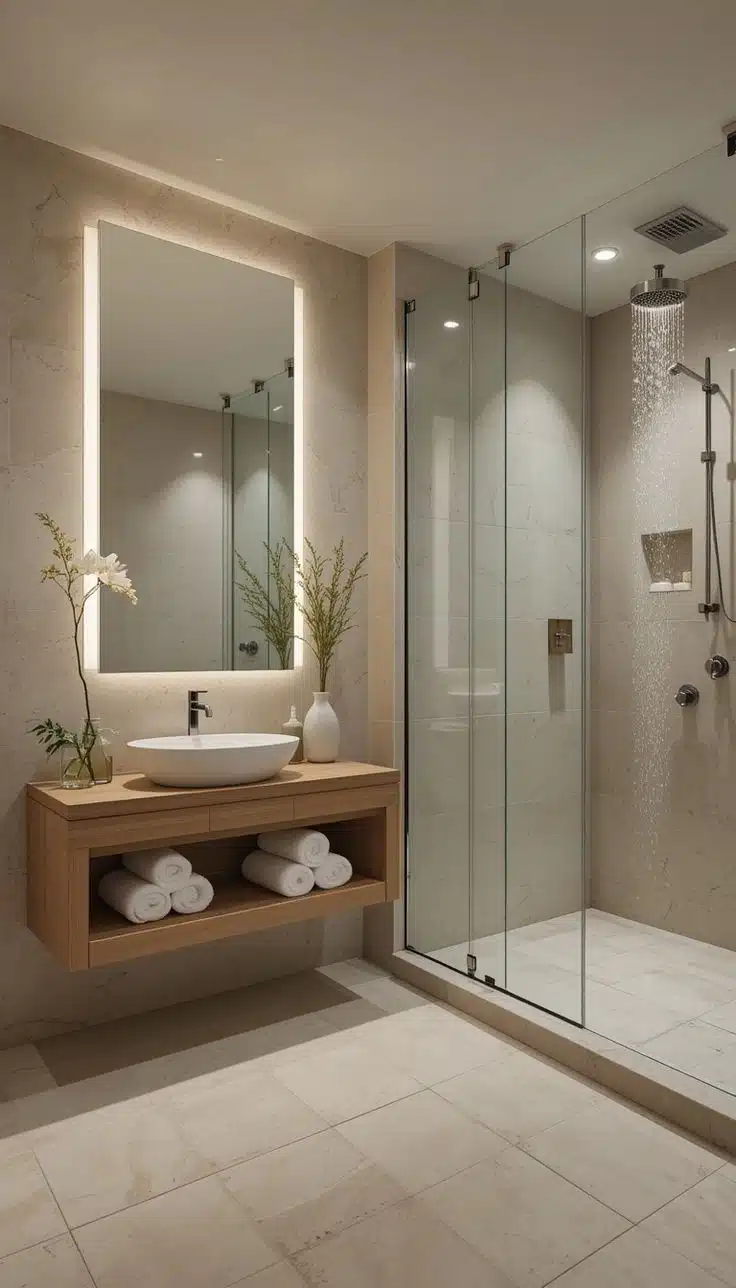
Discover the art and science of bathroom lighting to achieve the perfect balance between function and beauty. Your 2025 comprehensive guide to designing safe, elegant lighting that transforms your bathroom into an oasis of relaxation.
In modern interior design, the bathroom is no longer just a purely functional space; it has evolved into a personal sanctuary, a mini-spa, and a space for contemplation and relaxation away from the hustle of daily life. It is the place where we start our day with energy and end it with relaxation. With this dual role come unique and complex lighting requirements. The light we need for precise tasks in the morning is completely different from the soft glow we crave while enjoying a warm bath in the evening. The art of bathroom lighting is a delicate balance between science and aesthetics, between strict safety requirements and the desire to create a luxurious atmosphere.
Unfortunately, most bathrooms suffer from poor lighting, often limited to a single harsh ceiling fixture, which casts unflattering shadows on the face, makes daily tasks difficult, and completely fails to create any sense of comfort. This comprehensive guide will not just offer you fleeting ideas; it will take you on a deep journey to explore every aspect of bathroom lighting, from non-negotiable safety laws to the secrets of designers in creating light layers that transform this practical space into a complete sensory experience. Get ready to rediscover your bathroom, not as a room, but as a destination.

Part One: The Non-Negotiable Foundation – Safety First (A Detailed Explanation of IP Ratings)
Before we even think about aesthetics, we must talk about physics and regulations. The bathroom is a high-humidity environment where water and electricity meet, and this combination demands absolute respect for safety standards. The most important concept you must know is the Ingress Protection (IP) Rating.
An IP rating consists of two digits (e.g., IP44). Each digit has a specific meaning:
- The first digit (0 to 6): Indicates the level of protection against solid objects, like dust and fingers.
- The second digit (0 to 8): Indicates the level of protection against the ingress of liquids (water), and this is the most critical number in the bathroom.
To apply these standards correctly, the bathroom is divided into electrical “zones,” each with its own IP requirement:
- Zone 0: This is the area fully submerged in water, i.e., inside the bathtub or the shower basin. Any lighting fixtures here must be very low voltage (12V) and rated at least IP67, which means they are fully protected against temporary immersion in water.
- Zone 1: This is the area directly above the bath or shower, up to a height of 2.25 meters from the floor. This zone requires fixtures with an IP65 rating, ensuring protection from powerful water jets from any direction (like a handheld shower head).
- Zone 2: This is the area stretching 0.6 meters horizontally from the edge of the bath or shower and up to a height of 2.25 meters. It also includes the area around the sink. This zone requires a minimum rating of IP44, which provides sufficient protection against water splashes.
- Outside Zones: Any area outside Zones 0, 1, and 2 is generally considered safe, but it is always recommended to use fixtures with at least an IP20 rating.
When shopping for bathroom lighting, choosing a reputable brand like Nawartt becomes crucial. Trusted brands not only offer beautiful designs but also ensure that the IP ratings stated on their products are accurate and have been rigorously tested, giving you peace of mind and ensuring your family’s safety.
Part Two: The Art of Layering in the Bathroom Sanctuary
Just like any other room, perfect bathroom lighting relies on the three-layer strategy, adapted to meet the unique needs of this space.
Chapter 2.1: Ambient Lighting (The Overall Glow) This layer provides general illumination for the entire space, ensuring clear and safe visibility.
- Its Sources: The best option is a grid of recessed downlights, ensuring each unit has the appropriate IP rating for the zone in which it’s installed. A stylish central ceiling fixture (flush or semi-flush mount) with an IP44 rating can also be used to create a focal point. For a touch of luxury, cove lighting in the ceiling edges can add a soft glow reminiscent of a spa.
Chapter 2.2: Task Lighting (The Functional Core) This is the lighting that helps you perform your daily tasks accurately. It is the most important layer in the bathroom.
- Vanity Lighting (The Most Important of All): This is where most mistakes happen. The Common Mistake: Installing a single light above the mirror. This casts strong shadows under the eyes, nose, and chin, making shaving or applying makeup a nightmare. The Perfect Solution: Cross-Illumination. This is achieved by placing light sources on both sides of the mirror, at roughly eye level. This bathes the face in even light and eliminates all shadows. These sources can be in the form of vertical wall sconces or mirrors with integrated backlighting. It is essential here to choose lamps with a very high Color Rendering Index (CRI) of 90+, a feature that brands like Nawartt focus on in their vanity lighting solutions to ensure skin tones and makeup colors are seen with perfect accuracy.
- Shower Lighting: Do not neglect this area! Installing a single waterproof recessed light (IP65) inside the shower cabin makes a huge difference, transforming what was a dark “cave” into a bright, pleasant, and safe space.
Chapter 2.3: Accent Lighting (The Spa Vibe) This is the layer of magic that turns the bathroom into a resort.
- Its Sources: Use a small, aimable, waterproof spotlight to highlight a decorative tile wall or a humidity-loving plant. Waterproof LED strips can be installed in wall niches for shampoo and toiletries. Toe-kick lighting under a floating vanity also serves as a perfect guiding light at night.
Part Three: Mastering Vanity Lighting – A Specialized Guide
Due to its utmost importance, vanity lighting deserves its own chapter. The goal is to achieve shadow-free, bright, and color-accurate illumination.
- The Cross-Illumination Principle: As mentioned, the solution lies in having light on both sides of your face. This guarantees no shadows.
- Fixture Types:
- Vertical Wall Sconces: Considered the gold standard. Choose long sconces that distribute light along the length of your face. They should be installed so their midpoint is roughly at eye level (about 165-175 cm from the floor).
- Backlit Mirrors: A very sleek and modern solution. The light source is integrated behind the mirror, providing a soft, ambient glow around it, which is perfect for shadow-free facial lighting.
- Lighted Mirrored Cabinets: These units combine smart storage with perfect lighting. High-end options from suppliers like Nawartt often include extra features like integrated defoggers and internal power outlets.
- Dimensions and Spacing: For the best results with side sconces, they should be spaced 75 to 90 cm apart, with the mirror centered between them.

Part Four: Lighting for Different Bathroom Styles
Lighting is a powerful tool to enhance your chosen design style.
- The Modern Bathroom: Relies on simplicity and clean lines. Ideas include using integrated linear LED profiles in walls or ceilings, backlit mirrors, wall sconces with simple geometric shapes (cylinders, cubes), and “trimless” recessed downlights. Materials like chrome, brushed nickel, and matte black are prevalent.
- The Classic and Traditional Bathroom: Characterized by luxury and detail. Ideas include using ornate wall sconces on either side of the mirror with brass or bronze finishes, or even a small chandelier in the center of large bathrooms (observing safety rules and height). A collection of classic fixtures from Nawartt can add a touch of timeless elegance.
- The Farmhouse/Rustic Bathroom: Celebrates natural materials and a warm atmosphere. Ideas include wall sconces with a lantern or barn-light design, using materials like treated wood, wrought iron, and seeded glass.
- The Small Powder Room: Here you can be bolder. Since the space is small, a single fixture can be the star. Consider an elegant decorative pendant hanging beside the mirror instead of traditional sconces, or a pair of dramatic wall sconces.
Part Five: The Science of Ambiance – Lumens, Kelvin, and Dimmers
Here we dive into the technical details that differentiate a well-lit bathroom from an exceptionally lit one.
- Lumens: To measure brightness, you need a mix in the bathroom. For ambient light, aim for 20-30 lumens per square foot. But at the vanity area, you need at least 70-80 lumens per square foot directed at the task area. In general, a medium-sized bathroom needs a total of 7000 to 8000 lumens, with the majority concentrated around the mirror.
- Kelvin (CCT): Color temperature is very important in the bathroom.
- 3000K (Warm White): Excellent for creating a warm, cozy, spa-like feeling, ideal for ambient lighting.
- 4000K (Neutral White): Perfect for task lighting at the mirror, as it provides a clean, clear light that renders colors more accurately and helps with alertness in the morning.
- The Optimal Solution: Is to use different color temperatures in different layers (4000K for the vanity, 3000K for the ceiling), or to invest in Tunable White technology. This innovative tech, starting to appear in collections from forward-thinking brands like Nawartt, allows you to change the color temperature from warm to cool via an app or a special switch, giving you the best of both worlds.
- Color Rendering Index (CRI): In the bathroom, this number is non-negotiable. You need a CRI of 90+ at the vanity to ensure that your skin tone, hair color, and makeup look exactly as they will in natural daylight. It’s the difference between leaving the house looking perfect or looking completely different than you thought.
- Dimmer: The dimmer switch is the tool that unlocks the bathroom’s dual personality. Each layer of lighting should be connected to its own dimmer. This allows you to have bright, energizing light for your morning routine, and then dim everything for a soft, tranquil glow for a long, relaxing evening bath.

Part Six: The Smart and Future Bathroom
- The Programmed Scenes Idea: Elevate your bathroom experience to a new level by programming specific lighting “scenes” via a smart system:
- “Active Morning” Scene: All lights at 100% brightness and 4000K color temperature.
- “Relax (Spa)” Scene: Vanity lights off, cove and shower lighting dimmed to 20% at 2700K color temperature.
- “Night Light” Scene: Only the toe-kick light under the vanity is on at 5% to guide you in the dark without disturbing your sleep.
- The Chromatherapy Idea: This technique uses color-changing RGB LEDs, especially in the shower, to create therapeutic moods. Blue can be calming, while green is balancing. The availability of smart controllers compatible with Nawartt products can open the door to these advanced experiences.
- Smart Mirrors: The future brings us mirrors that not only illuminate but also display the weather, news, or even play music, all integrated with the general lighting system.
Conclusion: Your Bathroom, A Reflection of Your Well-being
Designing your bathroom lighting is a direct investment in your daily quality of life. It is the art of balancing the need for absolute clarity with the desire for complete tranquility. By giving utmost priority to safety, adopting the layered lighting strategy, focusing on mastering the vanity area lighting, and paying attention to minute technical details, you can elevate your bathroom from a mere necessary room into an essential part of your daily wellness routine. Stop seeing it as a practical space, and start designing it as a personal sanctuary. The right light has the power not just to illuminate a room, but to illuminate your spirit as well.
#Keyword_List #BathroomLighting #ArtOfBathroomLighting #BathroomLightingDesign #VanityLighting #BathroomIPRatings #LEDBathroomLighting #BathroomSconces #WaterproofLighting #Nawartt #LayeredLighting #BathroomDecor #SpaLighting #ColorRenderingIndex #CRI #SmartBathroomLighting #BathroomLightingIdeas #ShowerLighting #ModernBathroomLighting #InteriorDesign


